Plastic Pen
The Birth of a Plastic Pen: Precision Manufacturing from Raw Material to Finished Product
The plastic pen, an indispensable writing tool in our daily lives, is the result of a sophisticated manufacturing process that combines precision engineering, quality management, and efficient assembly. From the initial plastic pellets to the meticulously crafted finished product on store shelves, every step undergoes stringent control to ensure each pen writes smoothly and lasts reliably.
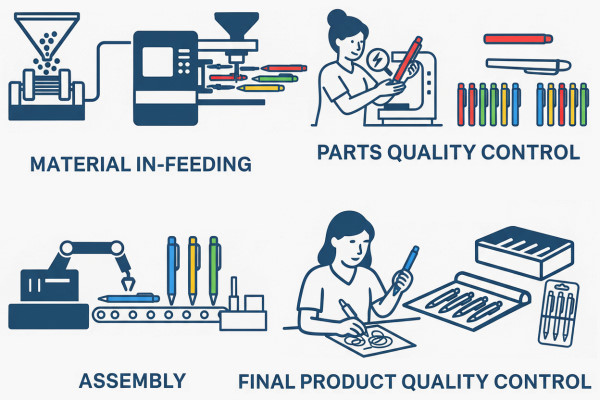
1. Material In-feeding
The first step in the production process is "Material In-feeding." This involves not only bringing raw materials into the factory but also rigorous screening and preparation.
Raw Material Types: Plastic pens typically use various thermoplastic pellets, such as Polypropylene (PP), Polystyrene (PS), Acrylonitrile Butadiene Styrene (ABS), and others. These materials are widely chosen for their excellent processability, durability, and cost-effectiveness. In addition, components like ink refills, springs, and ink are also sourced.
Quality Inspection: Incoming plastic pellets undergo strict physical and chemical testing to ensure they meet specifications, including melt flow index, density, and color uniformity. Non-conforming materials are rejected to prevent impact on subsequent production quality.
Drying Treatment: Many plastic raw materials are hygroscopic. To prevent bubbles or product defects during injection molding, materials are thoroughly dried, usually in a constant-temperature dryer for several hours, before entering the production line.
2. Injection Molding
"Injection Molding" is the core process for manufacturing the main plastic components of a pen, such as the barrel, cap, and clip, determining their dimensional accuracy and aesthetic quality.
Principle: Dried plastic pellets are fed into an injection molding machine. A screw inside the machine heats and melts the plastic, then injects the molten plastic under high pressure into precisely designed mold cavities.
Cooling and Solidification: The plastic quickly cools and solidifies within the mold, forming the desired part. The cooling time affects the part's dimensional stability and internal stress.
Demolding: Once solidified, the parts are ejected from the mold by robotic arms or ejector pins.
Mold Design and Maintenance: Molds are critical to successful injection molding. Their design must be precise to produce parts with stable dimensions and smooth surfaces. Regular maintenance and cleaning of molds are essential for maintaining production efficiency and product quality.
Parameter Control: During injection molding, parameters such as temperature, pressure, injection speed, and cooling time must be precisely controlled to ensure consistency across all parts.
3. Parts Quality Control (Parts QC)
After injection molding, plastic parts undergo rigorous "Parts Quality Control" to ensure they meet design requirements.
Dimensional Inspection: Tools such as calipers, vernier calipers, and optical image measuring instruments are used to check critical dimensions like length, diameter, and wall thickness of components like pen barrels and caps, ensuring they are within tolerance.
Appearance Inspection: Manual or automated visual inspection systems check part surfaces for defects such as burrs, sink marks, deformation, color variations, scratches, or stains.
Functional Testing: For example, the elasticity of a pen clip or the fit between a pen cap and barrel are subject to sampling tests.
Durability Testing: Key parts may undergo drop tests and wear resistance tests to simulate daily wear and tear.
Batch Sampling: While sampling inspection is common, critical dimensions and appearance may require increased inspection frequency or 100% inspection.
4. Assembly
Qualified parts that pass Parts QC move to the "Assembly" stage, where all components are put together to form a complete pen. Assembly can be done manually or through automation.
Refill and Tip Assembly: The ink refill (containing ink and a ballpoint) is assembled with the pen tip, which is crucial for writing functionality.
Spring and Retraction Mechanism: For retractable pens, springs and the retraction mechanism must be precisely assembled to ensure smooth clicking action and reliable tip extension/retraction.
Barrel and Other Components: The pen barrel, cap, clip, and other plastic parts are assembled. This may involve snap-fits, threads, or ultrasonic welding for connection.
Automated Assembly Lines: Large-scale production typically utilizes automated assembly lines, where robotic arms and automatic feeding systems significantly improve efficiency and consistency.
Human-Machine Collaboration: Some complex assembly steps may still require manual operation, implementing a human-machine collaborative production model.
5. Finished Product Quality Control (Finished Product QC)
Assembled pens enter the "Finished Product Quality Control" stage, the final safeguard for ensuring the quality of the end product.
Writing Test: Every batch of products undergoes strict writing tests. Testers check the pen's writing smoothness, uniform ink flow, clarity of handwriting, and absence of ink skips or leaks.
Appearance Inspection: The finished pen's appearance is re-inspected to ensure no scratches, dirt, or misalignment from assembly.
Functionality Test: For retractable pens, the retraction mechanism's sensitivity and durability are repeatedly tested; for capped pens, the cap's seal and securing force are checked.
Drop Test and Durability Test: Random samples are subjected to drop tests to simulate impacts that may occur during daily use, ensuring structural integrity.
Pre-packaging Inspection: Ensuring all products conform to customer-required labels, printing, and instruction manuals.
6. Packaging
Finished pens that pass all quality control checks proceed to the "Packaging" stage, preparing them for market entry.
Cleaning and Organization: Before packaging, pens may be cleaned to remove any dust or fingerprints acquired during production.
Individual Packaging: Single pens may be placed in clear plastic sleeves, blister cards, or individual boxes.
Multi-pack Packaging: A common packaging method involves grouping multiple pens into sets, such as multi-color pen sets or specific quantity packs.
Labeling and Barcoding: Product information, brand logos, barcodes, and batch numbers are printed or affixed to the packaging.
Cartoning: Packaged pens are neatly placed into cardboard boxes, sealed, and
labeled for easy transportation and warehousing. Automated Packaging Lines: Large manufacturers utilize automated packaging equipment to
enhance efficiency and packaging quality. From the strict screening of plastic
pellets to precise injection molding, through multiple layers of rigorous
quality inspection, and finally to assembly and elegant packaging, the
production process of a plastic pen is a highly coordinated industrial flow
driven by precision. Every step is designed to ensure that each pen in the
consumer's hand is a reliable and enjoyable writing tool
Contact Us
Pai Pen Pro International Ltd.
- 1F., No. 5, Lane 536, Xinming Rd.,
Neihu Dist., Taipei City 11466, Taiwan - +886-2-2794-5506
- +886-2-2792-5788
- info@paipenpro.com